

If you want to make money with AI, improving your credit score can also help you build a stronger financial foundation for future opportunities. A good credit score can make it easier to qualify for credit cards and loans and may help you access better borrowing terms. But improving your credit can take time, especially when you are trying to understand payments, balances, debt, and your credit report.
So, can AI help you improve your credit score?
Yes—but not by magically increasing your score.
You can use AI as a financial organization and planning assistant to understand credit habits, create payment plans, monitor spending, manage debt, and build better financial routines. The actual improvement still comes from responsible credit behavior over time.
In this guide, you will learn how to use AI to improve your credit score without relying on unrealistic promises or risky shortcuts.
Can AI Really Help Improve Your Credit Score?
AI cannot directly control your credit score or ask a credit bureau to increase it.
What AI can do is help you make better-informed decisions.
For example, AI can help you:
Organize your monthly bills
Create a debt repayment plan
Track credit card balances
Understand credit utilization
Review spending patterns
Create payment reminders
Prepare questions about your credit report
Build a long-term credit improvement plan
Your credit score is ultimately influenced by information in your credit reports and the scoring model being used. Different scoring models can also calculate scores differently.
That is why AI should be treated as a planning tool—not a credit repair service or financial advisor.
How to Use AI to Improve Your Credit Score
Before using AI, it helps to understand what you are actually trying to improve.
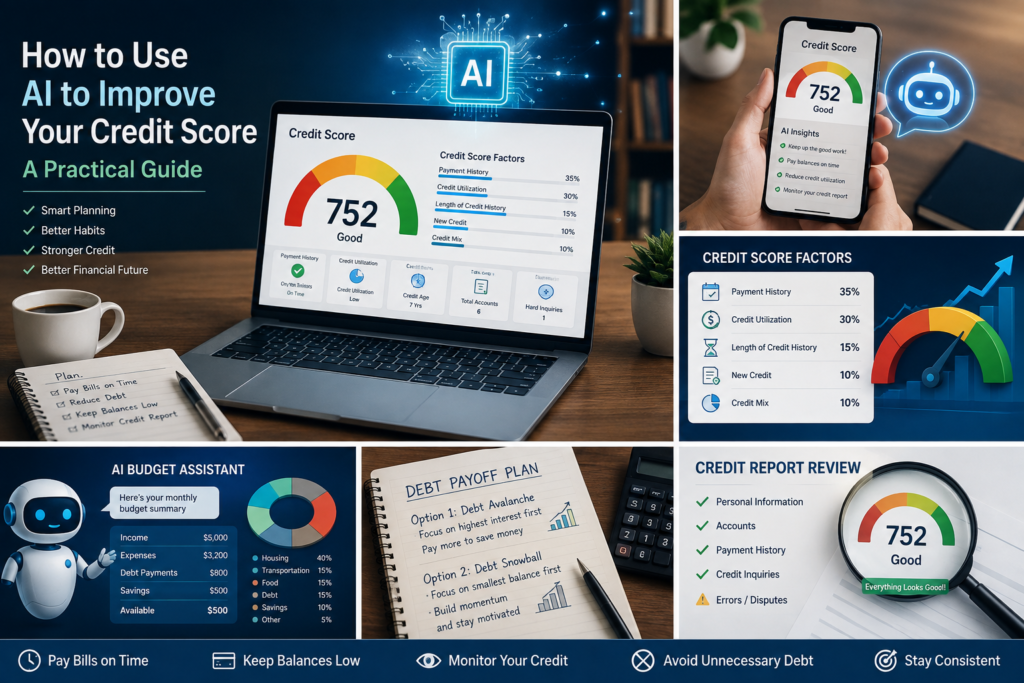
For FICO Scores, the major categories include payment history, amounts owed, length of credit history, new credit, and credit mix. Their relative importance can vary depending on an individual’s credit profile.
Payment History
Making payments on time is one of the most important parts of maintaining healthy credit.
AI can help you organize due dates and create a monthly payment checklist.
Credit Utilization
Credit utilization refers to how much of your available revolving credit you are using.
For example, if a credit card has a $5,000 limit and the balance is $1,000, the utilization is 20%.
AI can help you monitor balances and create a plan for paying them down.
Length of Credit History
The age of your credit accounts can also affect some credit scores.
AI cannot make an account older, but it can help you understand your credit history and make more informed decisions about your existing accounts.
New Credit
Opening several new credit accounts within a short period can affect your credit profile.
AI can help you organize your existing accounts and prepare questions to consider before applying for new credit.
Credit Mix
Having experience with different types of credit can be one factor in some scoring models.
However, you should never take on debt simply to improve your credit mix.
7 Ways to Use AI to Improve Your Credit Score
1.Use AI to Create a Credit Improvement Plan
The first step is to understand your current situation.
You can give an AI tool general, non-sensitive information such as:
Approximate credit card balances
Credit limits
Interest rates
Monthly income range
Monthly debt payments
Financial goals
Then ask AI to help organize the information.
Example AI Prompt
“Help me create a realistic credit improvement plan based on my monthly budget, credit card balances, and payment goals. Focus on responsible payment habits and reducing debt. Do not assume that my credit score will increase by a specific number.”
This can give you a starting framework rather than a guaranteed result.
2.Use AI to Track Credit Card Utilization
Credit card balances can be difficult to manage when you have multiple accounts.
You can use AI to organize your balances and limits into a simple table.
For example:
Credit Card
Credit Limit
Balance
Card A
$5,000
$1,000
Card B
$3,000
$900
Card C
$2,000
$300
You can then ask:
“Organize these credit card balances and calculate the utilization percentage for each account. Explain which balances I should review first based on utilization, without promising a specific credit score increase.”
Important: Keep actual card numbers, login details, passwords, and other sensitive information out of AI prompts.
3.Use AI to Build a Payment Plan
Missing payments can be damaging to your credit history.
AI can help you create a calendar showing:
Payment due dates
Minimum payments
Extra payments
Debt balances
Monthly cash-flow requirements
Try:
“Create a monthly payment checklist using these bills and due dates. Prioritize making all required payments on time and keep the plan within my stated monthly budget.”
The AI-generated plan should be checked against your actual bills and account information.
4.Use AI to Create a Debt Payoff Strategy
High-interest debt can make it difficult to free up money for savings and other goals.
AI can help you compare two common approaches:
Debt avalanche: Focus extra payments on the debt with the highest interest rate.
Debt snowball: Focus extra payments on the smallest balance first.
Ask:
“Compare the debt avalanche and debt snowball methods using these balances, interest rates, and minimum payments. Explain the advantages and disadvantages of each approach.”
AI can organize the information, but you should verify the calculations and make sure the strategy fits your actual budget.
5.Use AI to Analyze Your Spending

Sometimes the problem is not only debt—it is the spending habits that make debt harder to pay down.
AI can help categorize a sanitized spending list into areas such as:
Housing
Food
Transportation
Subscriptions
Entertainment
Shopping
Debt payments
Other expenses
Then ask:
“Review these spending categories and identify areas where I may be able to reduce expenses without cutting essential needs.”
This can help you find money that could potentially go toward debt payments or savings.
6.Use AI to Understand Your Credit Report
Credit reports can contain a lot of information, and some sections can be difficult to understand.
AI can help explain unfamiliar terms or organize information into plain language.
For example:
“Explain these credit report terms in simple language and tell me which information I should verify for accuracy.”
However, do not blindly trust AI to determine whether an entry is legally inaccurate or whether it should be disputed.
If you find information that you believe is inaccurate, verify the information and follow the appropriate dispute process with the relevant credit reporting agency.
For U.S. consumers, the federal government provides information about obtaining and checking credit reports through USA.gov.
7.Use AI to Build Better Financial Habits
Improving credit is not only about one payment or one credit card.
It is about building consistent habits.
AI can help you create:
Monthly financial checklists
Bill-payment reminders
Spending reviews
Debt-payoff milestones
Savings goals
Monthly budget reviews
Try asking:
“Create a simple monthly financial checklist that helps me stay organized with bills, debt payments, spending, and savings.”
The goal is to make good financial habits easier to maintain.
AI Prompts You Can Use for Credit Improvement
Here are some ready-to-use prompts.
Credit Budget Prompt
“Help me create a monthly budget that prioritizes essential expenses, minimum debt payments, savings, and additional debt payments while staying within my income.”
Credit Utilization Prompt
“Help me understand my credit utilization using these credit limits and balances. Explain what the numbers mean and what I should monitor.”
Debt Payoff Prompt
“Compare the debt avalanche and debt snowball methods for my debts. Show me the pros and cons of each without guaranteeing a credit score increase.”
Spending Review Prompt
“Analyze these spending categories and identify potential areas where I could reduce expenses and redirect money toward debt or savings.”
Credit Report Prompt
“Explain these credit report terms in simple language and give me a checklist of information I should verify for accuracy.”
How Long Does It Take to Improve a Credit Score?
This is where you should be careful with online promises.
There is no universal number of days or points that applies to everyone.
Your results can depend on factors such as:
Your current credit history
Payment history
Existing balances
Credit utilization
Type of accounts
New credit activity
Information reported to the credit bureaus
The scoring model being used
Therefore, avoid websites or AI tools promising something like “increase your credit score by 100 points in 30 days.”
A more realistic approach is to focus on consistent financial behavior and monitor your progress over time.
What AI Cannot Do for Your Credit Score
AI has limitations.
It cannot:
Guarantee a higher credit score
Remove legitimate negative information
Control credit bureaus
Change your credit history
Guarantee loan approval
Guarantee a specific interest rate
Replace professional financial advice
Predict your exact future credit score with certainty
If an AI tool promises a guaranteed credit-score increase, treat that claim with skepticism.
Protect Your Financial Information When Using AI
This part is extremely important.
Never give an AI chatbot sensitive information such as:
Social Security numbers
Bank passwords
Credit card numbers
Online banking login details
Security answers
Full account numbers
Authentication codes
Instead, remove identifying information before asking an AI tool to analyze your finances.
For example, use:
“Credit card balance: $2,500”
rather than providing your actual card number or account information.
Also remember that different AI services have different privacy policies and data-handling practices. Understand how the service handles information before entering personal financial data.
Common AI Credit-Improvement Mistakes to Avoid
Following AI Advice Without Checking It
AI can produce incorrect or outdated information.
Verify important financial information through reliable sources.
Expecting an Instant Credit Score Increase
Credit improvement generally requires consistent behavior over time.
Giving AI Sensitive Financial Data
Use anonymized or generalized information whenever possible.
Opening New Accounts Just to Improve Credit Mix
Never borrow money you do not need simply because an AI tool suggests that it might help your credit profile.
Using AI as a Credit Repair Company
AI can help you understand and organize information, but it does not have the authority to erase legitimate negative information from your credit history.
A Simple AI Credit-Improvement Routine
If you want to keep things simple, try this monthly routine:
Week 1: Review your spending and upcoming bills.
Week 2: Check your credit card balances and debt progress.
Week 3: Review your budget and identify unnecessary expenses.
Week 4: Update your goals and prepare for the next month.
You can ask AI to turn these steps into a personalized checklist based on your budget.
The important part is consistency, not
Frequently Asked Questions
Can AI increase my credit score?
AI cannot directly increase your credit score. It can help you organize payments, manage spending, understand credit concepts, and create a plan that supports healthier credit habits.
Can ChatGPT help me improve my credit score?
ChatGPT or another AI chatbot can help explain credit concepts, organize general financial information, and create budgeting or debt-management plans. However, it should not be treated as a guaranteed credit-repair solution or a substitute for professional financial advice.
Can AI check my credit report?
AI can help explain information you provide and organize it into easier-to-understand categories. You should obtain your actual credit report through an appropriate official source and verify information yourself.
How can AI help with credit card debt?
AI can help organize balances, interest rates, minimum payments, and budgets. It can also help you compare debt-payoff strategies and create a payment checklist.
Is it safe to give AI my credit card information?
It is best not to give an AI chatbot your full credit card number, passwords, Social Security number, account credentials, or other sensitive financial information. Use generalized or anonymized information instead.
Final Thought
Learning how to use AI to improve your credit score is less about finding a magic AI tool and more about using technology to build better financial habits.
AI can help you organize your budget, understand credit utilization, plan debt payments, review spending, and stay consistent with your financial goals.
But remember: AI does not control your credit score—you do your part through responsible financial behavior.
Start with one simple step today: organize your monthly payments and spending, create a realistic plan, and review your progress regularly.
Over time, those small, consistent habits can be much more valuable than any promise of a quick credit-score fix.